
There are some literary terms we all sort of know. We’ve heard them in workshops, we’ve probably nodded thoughtfully when someone else used them, and we may have even used them ourselves. But then someone asks, What is the difference between a motif and a symbol? And the room gets quiet.
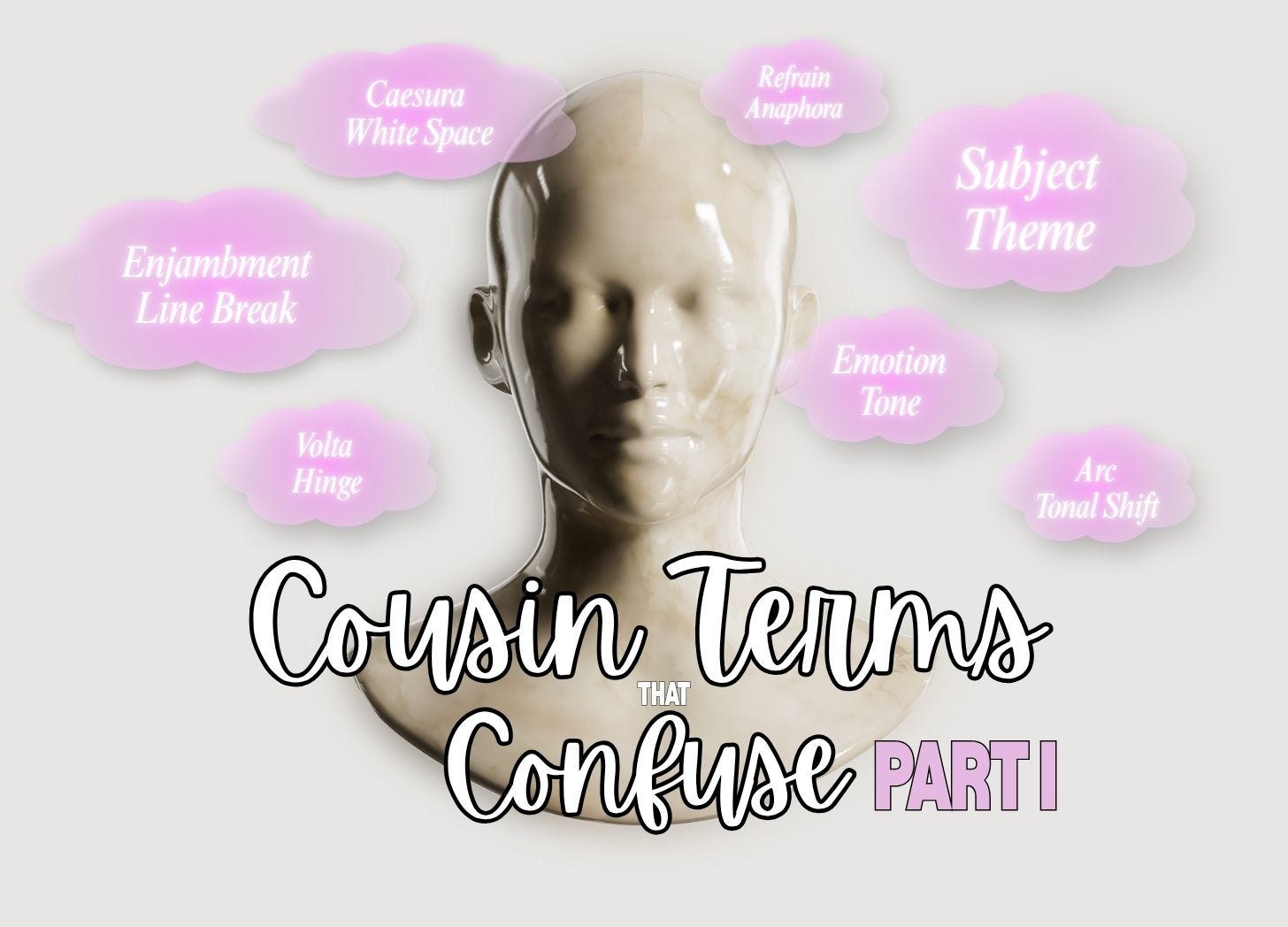
Most of these terms aren’t difficult on their own, what makes them confusing is that they overlap, or that the nuance between them is tissue-paper thin.
Before we start, see how many of these you can decipher without looking them up:
Refrain vs. Anaphora
Enjambment vs. Line Break
Caesura vs. White Space
Volta vs. Hinge vs. Tonal Departure vs. Arc
Tone vs. Emotion vs. Theme vs. Subject
How’d you do?
Refrain / Anaphora
A refrain is a phrase, line, or set of lines that deliberately returns at intervals during a poem.
Think of it as the poem coming back to the same place. The repetition may remain identical, or it may change slightly each time. A refrain can create ritual, obsession, music, escalation, comfort, or pressure.
And because the poem changes around it, the same sentence can mean something very different by the third time we encounter it. That’s often the point: effective repetition does not necessarily have to change its wording, but something around it—context, pressure, expectation, association, or meaning—can continue to build or change. Repetition, not redundant.
Anaphora is repetition at the beginning of successive lines, clauses, or phrases.
For example:
Remember the blue room.
Remember the broken lock.
Remember the open window.
The repeated “Remember” is anaphora. This is where anaphora and refrain get confused. The same repeated language can sometimes function as both. If a phrase repeatedly begins successive lines, it is anaphora because of where the repetition occurs; if that same phrase also returns as a recognizable recurring element in the poem, we might reasonably talk about it as a refrain too.
However, a refrain may disappear for several lines or stanzas before coming back, but if the repeated language keeps striking the beginning of line after line like a drumbeat, you’re probably looking at anaphora.
Enjambment / Line Break
These two get confused because both involve the end of a poetic line. But a line break tells us where the line ends. Enjambment tells us something about what the syntax is doing when it gets there.
A Line Break is simply the point where one line ends.
Which sounds almost too obvious to define, but in poetry, the decision of where to end a line can dramatically change how a sentence feels. Because a poet chooses where the line ends, the break becomes part of the poem’s form, and with that choice comes the possibility of intention. A line ending can create emphasis, expectation, suspension, or pressure.
Consider:
I wanted to tell you the knife
was already buried.
or
I wanted to tell you
the knife was already buried.
The sentence is the same, but the pressure is different.
In the first version, knife is suspended at the edge of the line. In the second, the eye encounters the line ending after you, which can briefly intensify the act of telling before the next line reveals what must be said. A line break does not automatically command an audible pause, but words at line beginnings and endings often carry additional positional emphasis because of how the line frames them.
Enjambment happens when a sentence or phrase continues across a line break without grammatical closure.
For example:
I wanted to kill
my darlings.
vs.
I wanted to kill my darlings.
The syntax carries us across the break. The first line is not grammatically finished. We have to visually cross the line break to complete the thought. That break can create suspension, pull, or complication; importantly, enjambment does not always make the reader stop. Enjambment can create suspense, double meaning, hesitation, surprise, misdirection, or emphasis. The words immediately before (and sometimes after) a line break can become unusually charged because the reader experiences the break before completing the sentence.
Consider:
I wanted to show you
the scars on my ankles.
or
I wanted to show you the scars
on my ankles.
Neither is wrong, but both are a choice. It’s the same sentence but with different emphasis and pressure. This is why enjambment is more specific than a line break. Every lineated poem has line breaks, but not every line break is enjambed. And, technically, the counterpart to an enjambed line is an end-stopped line: one in which the syntax comes to a meaningful completion at the line ending.
Useful Distinction:
A line break, then, is the larger structural choice, while Enjambment describes a particular way a poet can use that choice.
Caesura / White Space
Now we move away from what happens at the edge of the line and toward what happens inside and around it. Caesura and white space can both create interruption, silence, distance, hesitation, or emphasis. But they are not the same thing.
A caesura is a significant pause within a poetic line.
For example:
I loved him once. Or thought I did.
I loved him once—or thought I did.
I loved him or thought I did.
The comma, dash, and unusual spacing can all signal or produce an internal pause, depending on how the line is read. The reader is asked to stop, however briefly, before continuing through the rest of the line. Caesurae are often marked by punctuation, but punctuation does not automatically make a caesura, and a caesura does not require punctuation. The important thing is the perceptible break in the movement or rhythm of the line.
Enjambment and caesura can feel like opposing forces because one can carry syntax forward while the other interrupts movement, but they are not technical opposites. The technical contrast to enjambment is end-stopping, and a single line can contain both enjambment and caesura.
A single line with both:
I loved him once. Never
enough to stay.
The comma marks a pause, that functions as a caesura, inside the first line, while the unfinished syntax carries the reader across the line break into the second. The poem pauses and propels at the same time.
And then there is white space, which can create pause and emphasis without necessarily relying on syntax or punctuation at all.
White space is the empty space around or between words, lines, stanzas, and sections of a poem.
All written texts use empty space as part of their visual organization, but poetry can foreground that space as an active compositional element. A poet may separate two phrases with an unusual amount of space, isolate a single word, create a large gap between stanzas, or leave an entire portion of the page intentionally empty. That space can suggest silence, absence, hesitation, distance, time passing, disconnection, breath, or something ineffable.
A caesura may tell the reader, pause here. But white space can do something more spatial. It can make the pause visible, meta, and/or physical.
It can slow the eye before the mind has even interpreted the words. It can make absence occupy actual room on the page. A caesura names a pause in the movement of the line; white space names the visual and spatial absence surrounding or separating language. The two can absolutely overlap: white space can itself help create a caesura.
Useful Distinction:
A caesura creates or identifies a significant pause within the line. And white space uses the physical page itself to create separation, pacing, silence, or emphasis.
That’s why asking, “Why did you break the line there?” can become a much more interesting question than it first appears. The real question may be whether the poet wants us to move forward, stop, linger, misread, reconsider, or simply sit for a moment inside the silence the poem has made.
Volta / Hinge / Arc / Tonal Shift
A volta is a consequential turn in a poem’s thinking, argument, perception, or understanding.
The word literally means turn, and it is most famously associated with the sonnet tradition, where a poem often develops an idea, proposition, problem, or emotional position and then turns toward complication, response, reversal, or realization.
Imagine: a speaker who spends most of a poem insisting that she has forgiven someone. She has moved on. She barely thinks about it anymore. Everything is fine.
Then:
But every night I lock the bedroom door.
That line changes how we understand what we have already read. Perhaps the speaker has not forgiven as completely as she believed, or forgiveness and fear are existing simultaneously. Or maybe the poem has been telling us one story while preparing us another one.
That is one of the important powers of the volta: it can alter the meaning of material that came before it.
Now, hinge gets complicated, because it is not universally a separate technical category. Some poets, critics, and teachers use hinge as another word for a volta or turn. For the purposes of this essay, though, I’m going to use hinge in a nuanced structural sense: a point that connects two parts of a poem and allows movement between them without necessarily complicating or forcing us to reconsider anything that came before.
The metaphor is useful because an actual hinge allows one part of a structure to move in relation to another while keeping the pieces attached. In a poem, the hinge might be a single word:
But. Still. Yet.
Or it might be a phrase or deictic language:
Years later. I remember.
Sometimes it is an entire image, line, stanza, or sentence that carries the poem from one mode into another.
Imagine: a poem that spends two stanzas describing a childhood kitchen: the linoleum, the yellow light, onions softening in a pan, the mother standing at the counter.
Then the poem says:
Years later, in my own kitchen, I slice onions the same way.
In the vocabulary I’m using here, that line could function primarily as a hinge. It carries us from childhood into adulthood and from the mother’s kitchen into the speaker’s own, but it does not necessarily contradict, complicate, revise, or reframe what the first section meant. It opens one portion of the poem into another. A hinge is often structural in this way. It helps the poem move between sections, ideas, times, images, or modes of attention without necessarily overturning what came before.
A hinge may say: Now we are going here.
A volta may say: What we thought we knew is no longer enough.
And one line can be both.
The sentence about the locked bedroom door might structurally carry us into the poem’s final section and force us to reconsider the speaker’s claim of forgiveness. That is why identifying a “turn” is often only the beginning of the conversation. The more useful question is: What kind of turn is it?
Because hinge and volta are sometimes used interchangeably, I would not treat this distinction as a universal taxonomy. Rather, think of it instead as a useful workshop diagnostic. The distinction becomes much clearer if we ask: Is the poem being connected, or is the poem being reconsidered? Again, sometimes the answer is both.
An arc is the larger trajectory of change across a poem, or a collection. Often using turns to create it’s shape.
It is the path we can trace when we step back and ask: Where does this poem begin, and where does it end? Narrative poems usually have an obvious arc because events occur and circumstances change. But lyric poems can have arcs too, even when almost nothing “happens” in the conventional sense.
A poem may begin in certainty and end in doubt.
It may begin in accusation and arrive at tenderness.
It may move from childhood memory into adult understanding.
It may begin by observing something outside the speaker and gradually reveal that the speaker has been talking about themselves all along.
That larger movement is the poem or collection’s arc. And not every arc has to be dramatic. Sometimes the change is small.
A tonal shift is a recognizable change in the poem’s tone: its attitude, manner, register, or rhetorical temperature at a particular moment.
A poem might move from playful to ominous, detached to intimate, tender to furious, comic to devastating, restrained to ecstatic, or formal to conversational.
Imagine, a funeral poem that has been bureaucratically calm:
We signed the forms.
We chose the box.
We thanked the man behind the desk.
Then suddenly:
And I burned every bouquet from that room.
That is a tonal departure. A tonal departure may contribute to the overall arc, but it does not automatically create a fully developed one. Likewise, a poem can undergo a profound arc while maintaining almost exactly the same tone from beginning to end.
Useful Distinction:
A hinge, as I’m using the term here, connects or opens into the next part of the poem.
A volta marks a consequential shift in thought, argument, perception, or understanding.
Arc and tonal departure/shift, become easier to distinguish if we change scale:
An arc describes the poem’s larger path of development.
A tonal departure describes a recognizable change in how the poem sounds or what attitude it conveys at a particular point.
Tone / Emotion / Theme / Subject
These four get tangled constantly because all of them seem to answer some version of: What is this poem doing? But they are answering different questions.
Emotion is what is being felt within the poem—often, though not always, what the speaker or persona is experiencing.
A speaker may feel grief, anger, longing, jealousy, shame, relief, awe, loneliness, desire, fear, tenderness, or several contradictory emotions at once. Emotion belongs to the experiential life of the poem. The reader may, of course, feel something entirely different.
Tone, however, is the attitude the poem conveys through its manner of speaking—toward its subject, situation, audience, speaker, or some combination of these.
That means the emotion and the tone do not have to match. And when they don’t you get a baked-in friction.
A speaker can be grieving while the tone remains clinical:
The body arrived at 8:14.
They gave us a plastic bag for his watch.
The emotion underneath the poem may be enormous, but the tone is restrained. Another poem about grief might be furious, sentimental, sardonic, reverent, conversational, hysterical, detached, or even funny.
If emotion is what is felt, tone is closer to how the poem speaks from inside or around that feeling. This is why saying, “The tone is sad,” is sometimes less precise than it first appears. Sadness may be the emotion. But what is the poem’s attitude toward that sadness? Is it resigned? Bitter? Tender? Self-mocking? Numb? The answer begins to tell us about tone.
Theme is not the poem’s emotion or tone. Theme is the larger idea or question the poem develops.
BUT wait. There is an important caveat here. Theme is used differently across classrooms and workshops. Words such as love, death, and grief are very commonly called themes, and it’s not wrong to use the word that way. But if our goal is greater precision, it can be useful to distinguish the broad territory a poem enters from what the poem actually develops within that territory. For that purpose, I’m going to call the broad territory the subject and reserve theme for the idea, tension, question, or insight the poem develops through it.
For example: Grief, then, might be called a theme in the broad sense, but in this more precise framework it can also be understood as a subject. A poem may be about grief, but its thematic concerns could involve:
The way grief changes memory.
The impossibility of truly knowing another person.
The obligations of the living to the dead.
The persistence of ordinary life after catastrophe.
So rather than saying that love, death, family simply are not themes, I find it more useful to say that they are broad subjects until we ask what a particular poem is doing with them. Because the theme begins to emerge when the poem does something with them.
For example:
A poem may use the subject of motherhood to explore the theme that love and resentment can coexist.
It may use the subject death to ask whether memory preserves a person or slowly replaces them.
It may use love to examine how intimacy can require surrendering the fantasy of being completely understood.
Two poems can share exactly the same subject and have entirely different themes. Two poems can also share both, while carrying completely different emotional experiences and tones. And these categories are not sealed compartments. Grief, for example, might be the speaker’s emotion and also the poem’s subject. What matters is what we are trying to describe about how it functions.
Useful Distinction:
What is being felt? That gets us toward emotion.
What attitude does the poem take toward what is happening?
That gets us toward tone.
What is the poem broadly about—what material or territory is it engaging? That gets us toward subject.
What larger idea, question, or tension is the poem developing through all of this? That gets us toward theme.
Once we distinguish those layers, we can also understand why a tonal departure does not necessarily mean the emotion has changed, and why an emotional shift does not automatically mean the poem’s theme has changed. (i.e., a grieving speaker may suddenly become sarcastic without becoming less grief-stricken.)
The terms overlap because poems are complicated! The distinctions matter because….poems are deliciously complicated, and we love them.
None of these terms exists because writers need more vocabulary with which to sound impressive. They are useful because they give us ways to describe what a poem is actually accomplishing.
Instead of saying: Something feels strange here.
We can say (eh-um):
The refrain returns, but I’m not sure its meaning has changed enough yet. The anaphora is creating momentum, but the pattern breaks before I expect it to. That line break makes me briefly understand the sentence one way before the next line corrects me. The pause at the caesura is doing more emotional work than I expected. This feels like a hinge, but I’m not sure it becomes the poem’s volta. The tonal departure is dramatic, but the larger arc remains almost completely still. The emotion changes here, but the tone doesn’t. I know the poem is about grief, but I’m still trying to understand what it wants to say about grief.
And, that’s where terminology becomes pragmatic vs. a test of whether we “know the right word,” and certainly not as another way to make writers feel as though everyone else secretly received a glossary handout they somehow missed. The vocabulary gives us handles to grab on to when doing a deep dive. It lets us talk more precisely about why something works or what a poem might be asking us to notice. And, luckily, there are about thirty more cousin terms we should probably cover. But we’ll get there.
Follow along for Part II & III
Thank you for reading!
-NJ
www.NJSIMAT.com


